If you are preparing for a government job physical test and your target is to complete 1600 meter running in 5 minutes 30 seconds, simply running 1600m every day is not the best approach. You need a proper combination of speed, endurance, recovery, strength and race-pace practice.
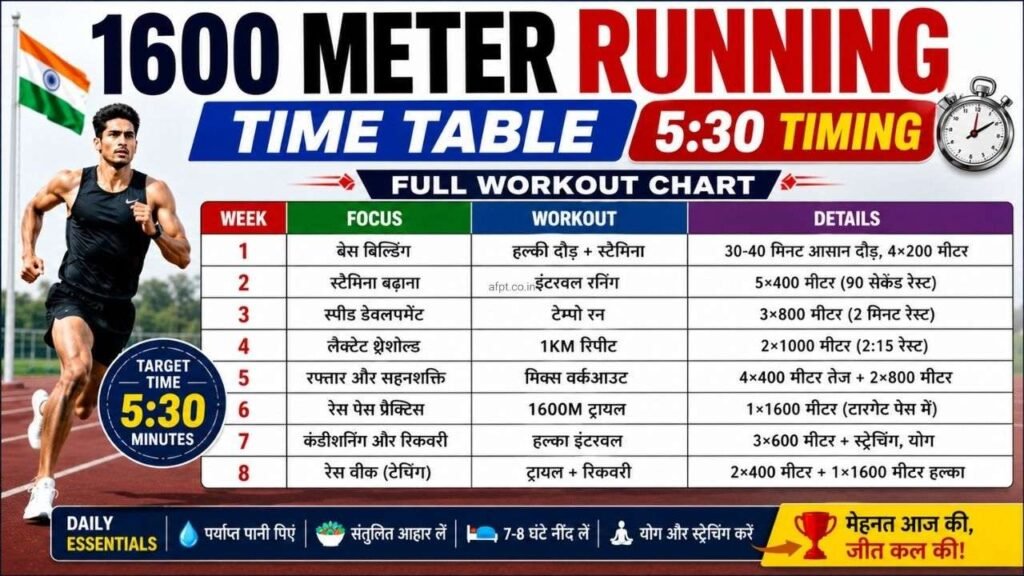
This 1600 meter running time table is designed for students, job seekers and physical test aspirants who want to work towards the 5:30 target in a systematic way. The plan includes a weekly schedule for beginners and intermediate runners, along with target splits, warm-up instructions, recovery tips and a practical method for tracking improvement.
One important point before starting: the 5:30 timing discussed here is a training target, not an official requirement of any particular recruitment. The actual running distance, time, PET/PST rules, height, chest, attempts and qualifying standards depend on the official notification of the recruitment you are applying for.
1600 Meter Running 5:30 Target: What Does It Mean?
A 5:30 finish means covering 1600 metres in exactly 5 minutes and 30 seconds.
That works out to an average pace of about 3 minutes 26 seconds per kilometre. For candidates training on a standard 400m track, the target becomes easier to understand through lap splits.
| Distance | Target Split for 5:30 |
|---|---|
| 400m | 1:22.5 |
| 800m | 2:45 |
| 1200m | 4:07.5 |
| 1600m | 5:30 |
You do not need to hit these splits perfectly from the first week. In fact, trying to run every training session at 1:22 per 400m can leave a beginner exhausted and increase the risk of overtraining.
The objective is to gradually bring your body closer to the required pace while improving your ability to maintain that speed.
1600 Meter Running Time Table: Weekly Schedule
A good weekly schedule should not contain hard running sessions on all seven days. Your body needs time to recover and adapt.
Here is a practical seven-day structure:
| Day | Training | Main Purpose |
|---|---|---|
| Monday | Easy Run + Strength | Aerobic base |
| Tuesday | 400m Intervals | Speed endurance |
| Wednesday | Recovery Jog/Walk | Recovery |
| Thursday | Tempo Run | Stamina |
| Friday | Short Intervals + Drills | Running speed |
| Saturday | 1600m Pace Practice | Race preparation |
| Sunday | Complete Rest | Recovery |
This schedule can be adjusted according to your present fitness level. A person who has never trained regularly should begin with less volume instead of immediately following the full workload.
Monday: Easy Running and Strength
Start the week with an easy run. The purpose is not to test your maximum speed.
Run at a comfortable pace for around 20 to 30 minutes, depending on your current fitness. You should be able to control your breathing rather than feeling like you are racing.
After the run, perform basic strength exercises such as bodyweight squats, lunges, calf raises, push-ups and a controlled plank.
Keep the strength session moderate. The objective is to build general physical strength, not to exhaust your legs before Tuesday’s speed session.
Tuesday: 400m Interval Training
Tuesday is the key speed-endurance session.
After a proper warm-up, run repeated 400m intervals with controlled recovery between repetitions.
For someone working towards a 5:30 1600m target, the eventual goal is to become comfortable around the required race pace. But beginners should start slower and increase intensity gradually.
A sample progression can look like this:
- Beginner phase: 4 × 400m at controlled hard effort with 2–3 minutes recovery.
- Intermediate phase: 5 × 400m with around 90–120 seconds recovery.
- Advanced preparation: 5–6 × 400m close to the intended race pace, provided your current fitness supports it.
Do not treat every interval session as a race. The final repetition should be difficult but technically controlled.
Wednesday: Recovery Day
Recovery is part of the 1600 meter running time table, not a wasted day.
You can perform 15–25 minutes of easy jogging or brisk walking. If your legs feel tired after Tuesday’s workout, choose walking instead of forcing another running session.
Light mobility work can also be included.
The purpose of Wednesday is to prepare your body for the next quality session.
Thursday: Tempo Running for Endurance
A 1600m runner needs more than short-distance speed. You must also be able to maintain a strong pace when fatigue starts building.
Tempo running helps develop this ability.
After warming up, perform a controlled sustained run. For beginners, 10–15 minutes of comfortably hard running is enough. Intermediate runners can gradually increase the duration.
The pace should feel challenging but sustainable. It should not feel like an all-out 1600m race.
Finish with an easy cooldown.
Friday: Speed Drills and Short Intervals
Friday can focus on running technique and shorter repetitions.
Begin with dynamic warm-up movements and running drills. Then perform short intervals such as 100m or 200m repetitions with adequate recovery.
The objective is to improve stride efficiency and speed without turning the workout into a maximum-effort sprint competition.
For example, an intermediate runner may use 6 × 200m with controlled recovery.
Beginners should use fewer repetitions and concentrate on maintaining good running form.
Saturday: 1600m Running Test Practice
Saturday is the most specific day of the week.
You should practise the actual 1600m distance regularly, but not necessarily at maximum effort every week.
A useful progression is:
- Week 1: 1600m controlled run
- Week 2: 1600m at a stronger but sustainable pace
- Week 3: 1200m pace workout followed by easy running
- Week 4: 1600m timed trial
This gives you a realistic picture of your progress without making every Saturday a full race.
During a timed trial, record your total time and, if possible, each 400m split.
For a 5:30 target, the eventual race pattern is approximately 1:22–1:23 per lap. However, your training should build towards this gradually.
Sunday: Complete Rest
Take one full rest day every week.
You can walk casually or perform very light mobility exercises, but there is no need for a hard running workout.
Sleep, food and recovery are especially important after several days of training.
5:30 Timing Kaise Banayein in 1600 Meter Running?
The biggest mistake many candidates make is trying to achieve 5:30 immediately.
Suppose your current timing is 7:00. Trying to suddenly run 5:30 means increasing your speed significantly in one jump. Instead, divide the goal into smaller improvements.
For example, you might first work towards:
7:00 → 6:40 → 6:20 → 6:00 → 5:45 → 5:30
The exact timeline will be different for every runner.
Your present fitness, age, running experience, body weight, recovery, training surface and previous injuries can all affect progress.
The important thing is to measure your improvement rather than comparing your timing with another candidate.
1600m Running Pace Chart for 5:30
Understanding pace can make your training much more practical.
| Checkpoint | Approximate Target |
|---|---|
| 200m | 41–42 sec |
| 400m | 1:22–1:23 |
| 800m | 2:45 |
| 1200m | 4:07–4:08 |
| 1600m | 5:30 |
These are race-target calculations, not instructions to run every workout at exactly these speeds.
For example, your easy run should be considerably slower than your target race pace.
The purpose of easy running is to develop endurance and allow recovery. Interval sessions are where you can work closer to your target pace.
1600m Running Time Table for Beginners
Beginners should not copy an advanced runner’s complete workout.
If you are starting from zero, spend the first few weeks developing basic running capacity.
A beginner-friendly weekly schedule can be:
- Monday: 20 minutes easy jog/walk
- Tuesday: 4 × 200m controlled running
- Wednesday: Rest or 20-minute easy walk
- Thursday: 15–20 minutes easy running
- Friday: 4 × 100m relaxed fast running
- Saturday: 800m–1200m controlled run
- Sunday: Rest
After your body becomes comfortable with regular training, you can gradually increase distance and introduce more structured 400m intervals.
There is no benefit in completing a very difficult workout once and then spending several days unable to run.
Warm-Up Before 1600 Meter Running
Never start a hard interval session immediately after reaching the track.
Begin with 5–10 minutes of easy jogging or brisk walking. Follow this with dynamic movements such as leg swings, controlled high knees, ankle movements and light running drills.
Then perform a few short progressive runs before starting your main workout.
A proper warm-up helps you move more freely and prepares your body for faster running.
Cool-Down After Running
After completing a hard workout, do not immediately stop and sit down.
Walk or jog slowly for several minutes so that your body can gradually return to an easier state.
Light stretching can be done after the session, particularly if it feels comfortable for you.
If you develop persistent pain, swelling or an injury that does not settle with rest, stop hard training and consult a qualified medical or sports professional.
How Many Days Should You Run for 1600m?
There is no single number that works for everyone.
A beginner may do well with three to four running days per week initially. A more experienced runner may handle additional sessions, provided recovery is adequate.
More running does not automatically mean faster running.
A better approach is to combine easy running with one or two quality sessions and sufficient recovery.
1600m Running Preparation: Common Mistakes
One common mistake is running 1600m at maximum speed every day.
Another is starting the first lap too fast. If you sprint the opening 400m, you may lose considerable speed during the final lap.
Candidates also sometimes ignore easy days. They believe that resting means losing fitness, but recovery is necessary for adapting to training.
Training only on a smooth track can also be misleading if the actual physical test is conducted on another surface. When possible, practise in conditions that are reasonably similar to the expected test environment.
Finally, do not suddenly increase running volume just because the physical test date is close.
Hydration, Food and Recovery
Training alone is not enough.
Drink sufficient fluids throughout the day, especially during hot weather. Avoid starting a hard session dehydrated.
Your regular meals should provide enough carbohydrates, protein, vegetables, fruits and other nutrients to support training.
There is no need for an expensive supplement just because you are preparing for a running test.
Sleep is equally important. If you are consistently sleeping poorly, your training quality and recovery can suffer.
1600m Running and Footwear
Use comfortable running shoes that fit properly and are suitable for the surface on which you train.
Do not wear a completely new pair of shoes for a physical test.
If possible, use your test-day footwear during some practice sessions so you already know how the shoes feel while running.
Replace footwear when it becomes excessively worn or uncomfortable.
How to Track Your 1600m Progress
Keep a simple running record.
Write down the date, distance, total time, workout type and how you felt during the session.
For example:
| Date | Workout | Time | Observation |
|---|---|---|---|
| Week 1 | 1600m Trial | 6:40 | Comfortable start, tired final lap |
| Week 2 | 1600m Trial | 6:28 | Better pacing |
| Week 3 | Intervals | — | Improved recovery |
| Week 4 | 1600m Trial | 6:15 | Stronger finish |
This record helps you see whether your training is actually working.
Instead of worrying about one bad running day, look at the trend over several weeks.
Is 5:30 Possible for Every Beginner?
Not necessarily, and nobody can honestly guarantee a particular timing.
A 5:30 1600m is a demanding target for someone who is completely new to running. Some candidates may reach it with consistent training, while others may require substantially more time.
Your starting point matters.
If you currently run 1600m in 6:00, your training requirement will be very different from someone currently running 8:00.
The right approach is to establish your current timing first and then build a realistic progression.
Physical Test, PET and PST: What Candidates Should Know
The terms PET, PST and physical test are used in many government recruitments, but their exact meaning and standards vary by department.
A recruitment may have a running event as part of the Physical Efficiency Test, while the Physical Standard Test may check measurements such as height and chest.
However, there is no universal 1600m physical standard applicable to every government recruitment.
Therefore, candidates should always check the notification for the specific post before preparing for a particular running distance or timing.
The reference training material used for this article is a general 1600m training plan, not an official recruitment notification.
Latest Physical Test Update
For the topic covered here, no particular recruitment, department or examination notification has been supplied.
Therefore, an official PET/PST date, admit card release date, physical-test venue, recruitment vacancy, height requirement, chest measurement or result date cannot be confirmed from the available information.
Official recruitment-specific update: Not officially confirmed yet.
Candidates should not treat a general 1600m training chart as an official physical-test notice.
Once you identify the exact recruitment, check its latest official notification for the applicable standards.
Physical Test Selection Process
The selection process also varies from one recruitment to another.
Some recruitments may include a written examination followed by PST/PET, document verification and medical examination. Others may use a different sequence.
Therefore, the exact selection order cannot be confirmed without the relevant recruitment notification.
Candidates should follow only the stages mentioned in the official advertisement for their post.
Eligibility and Physical Standards
Age limit, educational qualification, nationality, domicile, height, chest, weight and other physical conditions are recruitment-specific.
There is no single standard that can safely be applied to all candidates preparing for a 1600m running test.
For this reason, these details are not officially confirmed for any particular recruitment in this guide.
Before attending a physical test, read the notification carefully, especially the sections covering eligibility and physical standards.
Physical Test Admit Card
No recruitment-specific admit card has been identified in the information provided for this article.
Therefore, an admit-card release date or download link should not be assumed.
When an official admit card is released, candidates should download it from the recruitment authority’s official website and carefully check the reporting time, venue and instructions printed on it.
Documents Required at the Physical Test
Documents can differ between recruitments.
Depending on the official notice, candidates may be asked to carry items such as an admit card, valid photo ID, photographs, category certificate, domicile certificate or educational documents.
However, these should not be treated as universally mandatory.
Always follow the document list mentioned in your recruitment’s official notice.
Important Instructions for Running Test Candidates
Reach the venue according to the reporting time mentioned on the admit card.
Carry only the items permitted by the recruiting authority.
Avoid experimenting with new shoes, unfamiliar food or a completely new workout immediately before the test.
Do not attempt a very hard training session the day before the physical test. Your objective at that point should be to arrive rested and ready.
Most importantly, follow the instructions given by the physical-test officials rather than relying on information from social media or unofficial posts.
Physical Test Result
The result process depends on the recruitment authority.
Some departments may publish a list of qualified candidates, while others may provide the next-stage information through the candidate portal or recruitment notice.
Since no particular recruitment has been specified here, the physical-test result date and result-checking link are not officially confirmed yet.
Candidates should use the official recruitment website for the final result.
Can I Download the 1600 Meter Running Time Table PDF?
Yes, you can save this workout chart as a PDF for personal practice, but remember that this is a general training schedule, not an official recruitment document.
If your recruitment specifies a different running distance, timing or physical standard, follow the official notification instead of changing its requirements based on a general workout chart.
FAQs About 1600 Meter Running Time Table
What is the 1600 meter running time for a 5:30 target?
To finish 1600m in 5 minutes 30 seconds, the average target is approximately 1 minute 22–23 seconds per 400m lap.
How can I improve my 1600m running time?
Combine easy running, interval training, tempo work, strength exercises, recovery and regular 1600m practice. Increase training gradually rather than attempting maximum-effort runs every day.
Is 5:30 a beginner-friendly 1600m timing?
It is a challenging target for someone starting from zero. Your current fitness level will determine how quickly you can approach it.
How many days a week should I practise 1600m running?
Beginners can start with around three to four running days per week, with recovery days between harder sessions. More experienced runners may handle more training depending on fitness and recovery.
What should my 400m split be for 5:30?
The mathematical target is approximately 1 minute 22.5 seconds per 400m.
Should I run 1600m every day?
No. Daily maximum-effort 1600m runs are unnecessary and can interfere with recovery. A balanced weekly schedule is more practical.
Is there a different 1600m running standard for male and female candidates?
That depends entirely on the recruitment notification. There is no universal male/female standard that applies to every physical test.
When will the 1600m physical test admit card be released?
There is no single admit-card date for 1600m running. The date depends on the particular recruitment. For the recruitment discussed here, no official admit-card date has been provided.
For an actual government recruitment, candidates should use the official website of the concerned recruiting authority for the notification, admit card, physical-test schedule and result. No specific official recruitment URL was provided here, so no unverified link has been added.
Final Words on 1600 Meter Running Time Table
A good 1600 meter running time table is not about running at full speed every morning. The real focus should be on building endurance, improving speed gradually, learning proper pacing and giving your body enough time to recover.
For the 5:30 target, understanding the 400m split of around 1:22–1:23 is useful, but you should not expect to run that pace from the first day. Start from your current ability, follow a sensible weekly schedule and measure your progress through regular timed trials.
If you are preparing for a government job physical test, remember one final rule: the workout plan helps you prepare, but the official recruitment notification decides the actual PET/PST requirements. Check the latest official notice before the test and train according to the exact standard applicable to your post.